
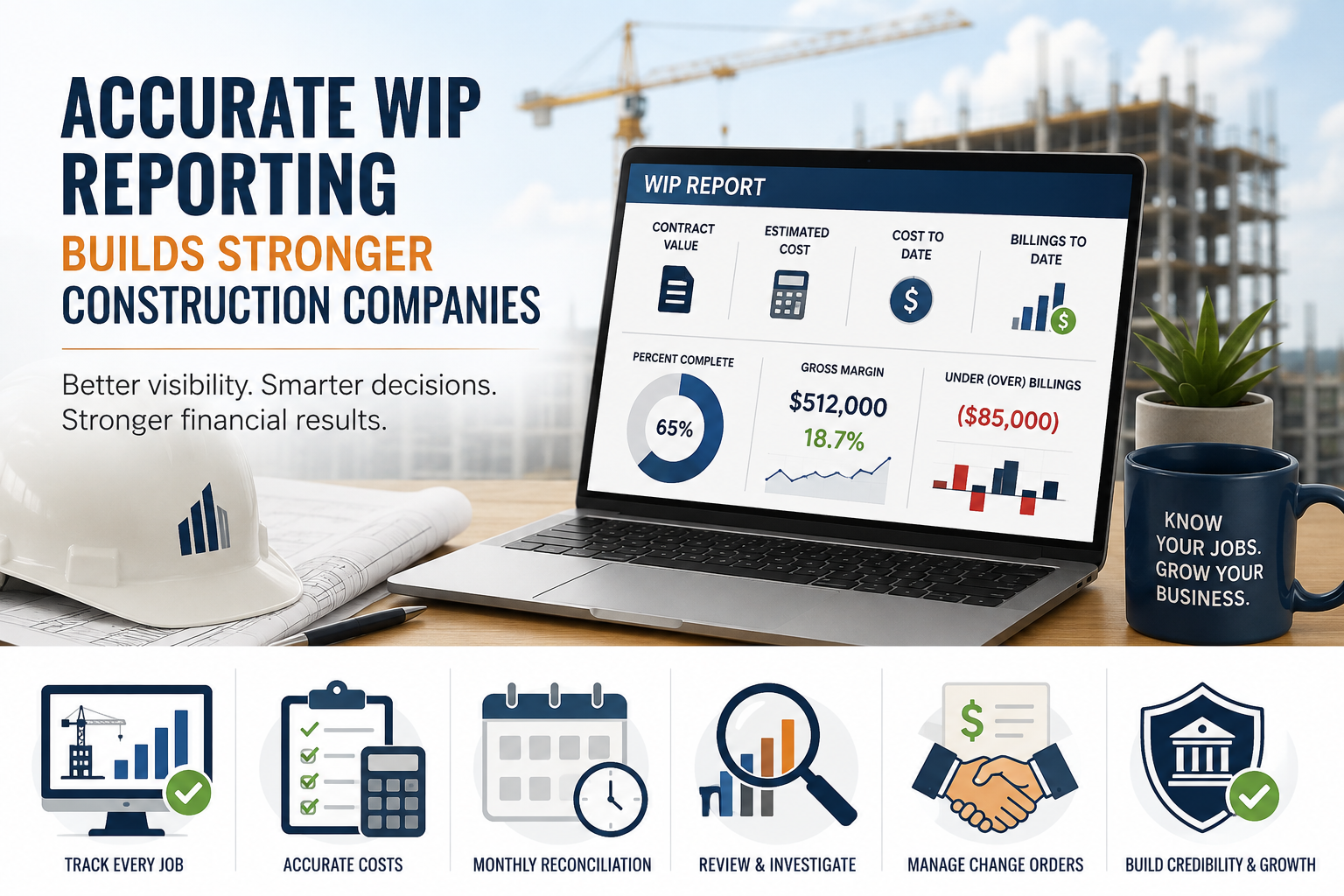
The reality is simple: your WIP report is one of the most important financial management tools your construction company has.
When maintained accurately, it provides a clear picture of job profitability, cash flow, billing position, and overall financial performance. When it is inaccurate, it can lead to poor decisions, cash shortages, unexpected losses, and uncomfortable questions from lenders and sureties.
What Is a WIP Report?
A Work in Progress, or WIP, report tracks the financial position of each active construction project.
Contract Information
- Original contract value
- Approved change orders
- Revised contract value
- Billings to date
Cost and Profitability Data
- Estimated total cost
- Cost incurred to date
- Estimated gross profit
- Gross margin percentage
Project Progress
- Percent complete
- Percent billed
- Estimated cost to complete
- Projected final profit
Financial Statement Adjustments
- Underbillings
- Overbillings
- Earned revenue
- Percentage-of-completion adjustments
Why WIP Accuracy Matters
Many construction companies assume they are profitable because the bank account looks healthy or customer payments are coming in. Neither of those indicators tells the entire story.
A contractor may receive a large mobilization payment and appear cash-rich while the underlying project is actually losing money. Another contractor may appear short on cash because a profitable project has not been billed promptly.
Inaccurate WIP Can Lead To
- Misstated financial statements
- Premature profit recognition
- Hidden profit fade
- Cash-flow surprises
- Bonding and banking concerns
- Poor management decisions
Accurate WIP Supports
- Better financial forecasting
- Stronger cash-flow management
- Earlier identification of job problems
- Improved estimating decisions
- Greater lender and surety confidence
- More sustainable growth
Six Practices That Improve WIP Accuracy
1. Use Construction-Specific Job Costing Software
Spreadsheets and generic accounting systems may work for very small contractors, but they become increasingly risky as project volume and complexity grow.
Construction-specific job costing systems provide better visibility into labor, materials, subcontractors, equipment, billings, committed costs, and profitability by project.
2. Continuously Update Estimated Job Costs
A project budget should not remain frozen simply because it was established when the job was awarded.
Labor shortages, material increases, weather delays, subcontractor issues, productivity challenges, and scope changes can all affect the expected cost to complete the project.
When estimates are not updated, the WIP report may recognize profit that the contractor will never actually earn.
3. Reconcile Job Costs Every Month
Monthly reconciliation helps ensure that payroll, subcontractor invoices, materials, equipment costs, credit card charges, and other job expenses have been assigned to the correct project and cost code.
Without this discipline, management may be evaluating project performance using incomplete or misclassified data.
4. Establish a Consistent Month-End Cutoff
Every reporting period should have a defined cutoff for costs, billings, change orders, and project updates.
Without a consistent closing process, WIP results continue changing after management believes the month has been completed. That makes trend analysis unreliable and often forces the accounting team to redo prior work.
5. Investigate Unusual Gross-Profit Swings
Large increases or decreases in projected gross profit should never be accepted without investigation.
Unexpected swings may indicate missing costs, incorrect estimates, improper cutoff, unrecorded change orders, billing errors, or genuine project-performance problems.
6. Manage Change Orders Aggressively
Poor change-order management is one of the fastest ways for a profitable project to become unprofitable.
Approved change orders should update both the contract value and estimated project costs. Pending or disputed change orders should also be tracked carefully so management understands the financial exposure.
WIP Reports Should Drive Business Decisions
Too many contractors view WIP reporting as a compliance exercise performed for the CPA, bank, or bonding company.
High-performing contractors use WIP reporting as an operating tool.
Accurate WIP information helps management:
- Forecast future revenue, profit, and cash flow
- Identify profit fade before a project is completed
- Compare actual results with original estimates
- Improve future bidding and estimating decisions
- Evaluate billing and collection performance
- Plan staffing and equipment needs
- Strengthen bonding capacity
- Make growth decisions with greater confidence
Do Not Wait Until Year-End
One of the biggest mistakes contractors make is preparing a WIP report only once a year.
By year-end, cost overruns, billing delays, missing change orders, and fading margins may have existed for months. At that point, the WIP report merely documents what went wrong.
Monthly WIP reporting gives management time to identify problems while there is still an opportunity to respond.
That is when WIP becomes more than an accounting schedule. It becomes a management tool.
How J&S Moore Financial Group Helps Contractors
At J&S Moore Financial Group, we help construction companies improve financial visibility through accurate job costing, WIP reporting, financial statement preparation, and strategic advisory services.
Our construction accounting team helps contractors:
- Develop reliable monthly WIP schedules
- Improve job-costing and month-end procedures
- Identify profit fade and unusual margin changes
- Prepare lender- and surety-ready financial statements
- Forecast cash flow and future profitability
- Use financial data to make smarter business decisions
Ready to Gain Better Visibility Into Your Projects?
Accurate WIP reporting is not just about satisfying your CPA or bonding company. It is about making better business decisions before problems become expensive.
